Why missed calls matter
A missed call is easy to underestimate because it looks small in isolation. One caller could not reach the office. One prospect left a voicemail. One customer said they would call again. But for call-heavy businesses, the pattern can become expensive.
The caller usually had a reason for choosing the phone. They may have wanted a faster answer than email, a more direct response than a chatbot, or a person who could help them decide. That makes many business calls high-intent moments, especially in service businesses, clinics, real estate, hospitality, automotive, and ecommerce support.
When those moments are missed, the loss is not only the call. The business loses context. It loses speed. It loses the ability to review what happened. And in some cases, it loses the chance to become the first company to respond while the customer still has momentum.
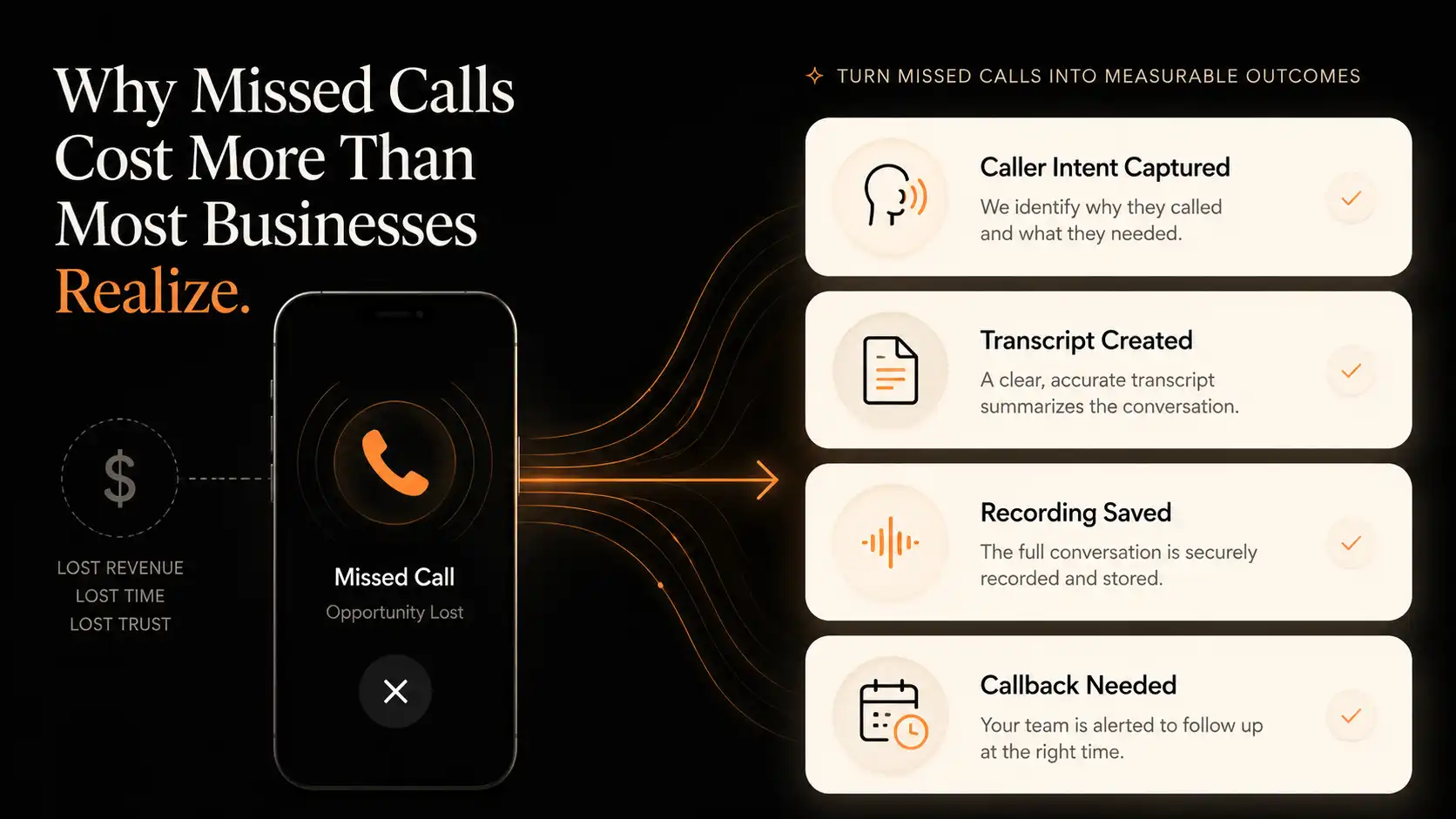
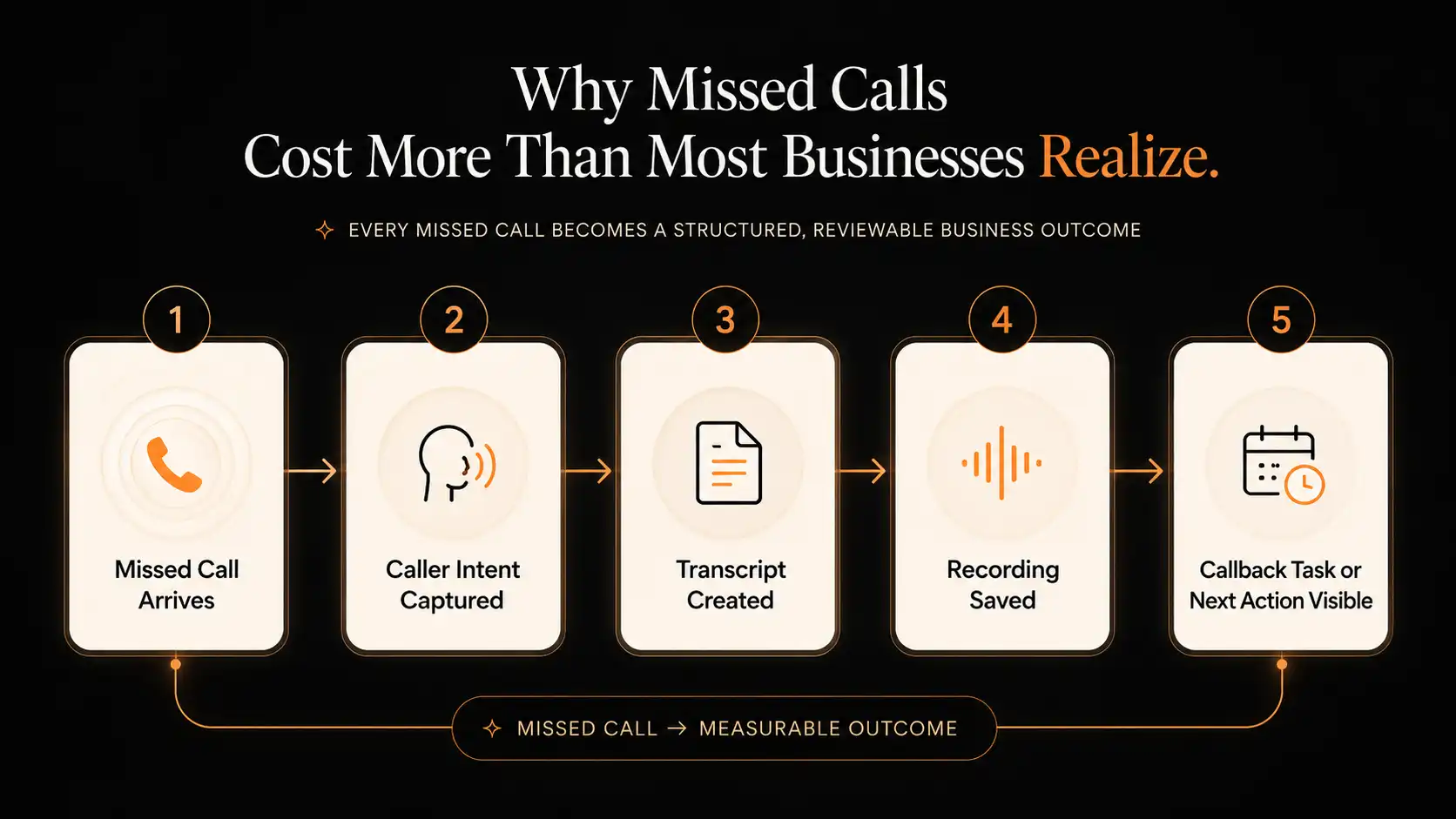
Missed calls cost businesses because they interrupt the path from customer intent to business outcome. The practical fix is not simply “answer more calls.” The fix is to capture the caller’s need, record the call, create a transcript, assign an outcome, and make the next action visible.
Where the workflow usually breaks
Most missed-call problems are not caused by lazy teams. They happen because the phone competes with active work. The front desk is helping someone in person. The dispatcher is coordinating a job. The agent is already on another call. The restaurant is in the middle of rush hour. The service advisor is handling a customer at the counter.
The problem appears when the business depends on manual recovery after the call is already gone.
- The caller leaves a vague voicemail with no clear urgency.
- The team calls back later but does not know exactly what the caller wanted.
- The customer has already contacted another business.
- The manager cannot review the original request.
- The follow-up note is scattered across phones, inboxes, or sticky notes.
Explore sample call logs, recordings, transcripts, and next-action cards before activating live handling.
What voicemail and manual callbacks miss
Voicemail is better than silence, but it is not the same as a structured call workflow. Voicemail may capture a message, but it often fails to capture the operational fields that matter after the call.
For example, a home service business may need the address, service type, urgency, access notes, and preferred callback time. A clinic may need the appointment request type and whether the call should be routed to a person. A dealership may need to know whether the caller wanted sales, service, parts, or BDC follow-up.
A simple voicemail does not reliably turn those details into a reviewable outcome. That means teams may still need to listen, interpret, call back, document, and route the request manually.
What a better missed-call workflow should capture
A better call workflow makes the missed-call moment easier to review and act on. Instead of leaving the business with a vague “someone called,” the workflow should create usable context.
Useful fields to capture
- Caller name and phone number
- Reason for calling
- Urgency level or handoff flag
- Requested service, appointment, order, lead, or callback
- Recording and transcript
- Outcome status
- Next action for the team
This does not mean every call should be handled fully by AI. Some calls should be routed to a human. The important point is that the workflow should make that boundary clear instead of letting the call disappear.
A simple way to estimate missed-call risk
No article can tell you exactly what every missed call costs. The value depends on your offer, margins, caller intent, close rate, appointment value, and how quickly the team follows up. But a simple estimate helps managers see whether the problem is worth fixing.
Scenario estimate formula
Treat this as a planning estimate, not a promise. The more important operational question is whether your team can review who called, why they called, what happened next, and which calls still need attention.
This is why recordings, transcripts, caller intent, and outcome status matter. Without those fields, the business only sees that the phone rang. With those fields, the business can review whether the call was urgent, whether it needed a callback, whether it should be routed to a person, and whether the follow-up actually happened.
Where RUU fits
RUU is designed as a managed AI voice system for businesses that need calls handled, logged, and reviewed. For missed-call workflows, RUU can help answer or follow up on structured call scenarios, capture caller intent, save recordings and transcripts, and make outcomes visible inside a dashboard.
RUU is not meant to replace human judgment. A sensitive, complex, urgent, or policy-specific call can be routed to a person. The value is that teams get AI call capacity for repeatable workflows while still keeping escalation paths available.
What to review inside the demo dashboard
Before activating live call handling, the RUU demo dashboard should help you understand how call workflows look after they are captured. Review sample call logs, transcript previews, recording cards, outcome statuses, and the difference between demo mode and live production.
Live AI call handling begins only after plan selection, verification, workflow setup, and production approval. That gives businesses a safer way to explore the system before connecting it to real customer calls.
Sources and research notes
The sources below are used as directional context for why unanswered calls, phone lead handling, and transparent AI workflows matter. They should not be read as guaranteed outcomes for any single business.
- CallRail, 2025 small business marketing benchmark report: useful context that phone-generated leads and marketing attribution matter across industries such as automotive, healthcare, home services, legal, and real estate.
- CallRail consumer survey on unanswered business calls: directional evidence that many consumers move on, leave voicemail, or contact another business when calls are not answered.
- Invoca 2025 Call Conversion Industry Benchmarks: phone call handling, answer rates, conversion rates, and paid-search phone lead performance are measurable operating metrics.
- Salesforce State of the AI Connected Customer: supports the need for transparency, human escalation, and responsible use of AI agents for lower-risk service and scheduling tasks.