
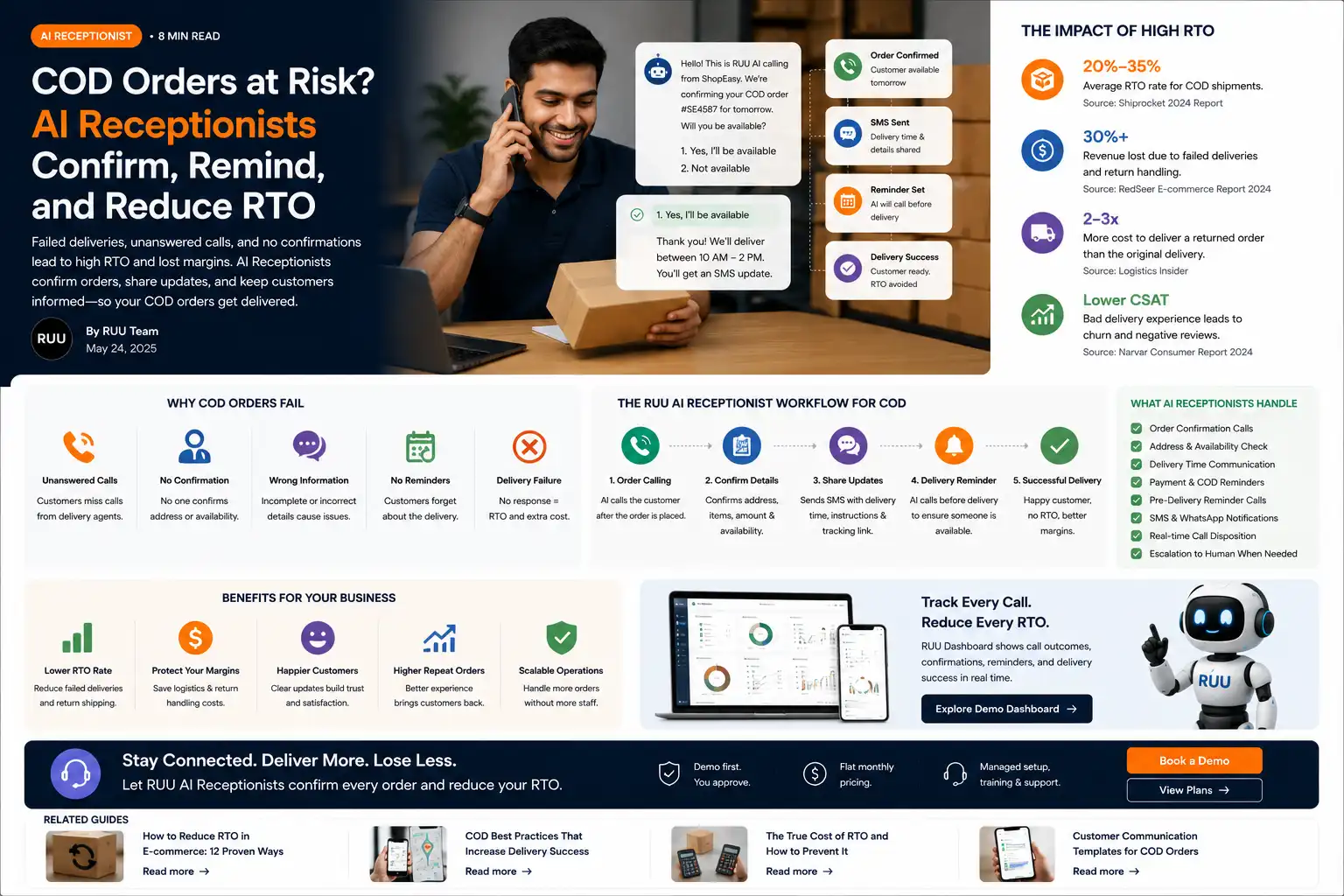
Why COD orders can cost more than they look
A cash-on-delivery order feels like a win at checkout. The buyer chose a product, entered their address, and placed the order. The sales dashboard records demand. The fulfillment team prepares the package. The brand expects revenue.
But COD is different from prepaid ecommerce. The customer has not paid yet. They may change their mind, ignore the delivery call, give an incomplete address, refuse the shipment, be unavailable during delivery, or decide they found a better option before the package arrives. When that happens, the brand does not simply lose a sale. It may also absorb forward shipping, return shipping, packing time, inventory lockup, support effort, and customer-experience damage.
That is why COD order confirmation should be treated as a workflow, not a manual side task. The business needs a reliable way to confirm intent before the order becomes expensive to recover.
COD order confirmation can reduce avoidable shipping risk by checking buyer intent, address accuracy, delivery availability, and payment readiness before dispatch. It does not prevent every RTO, but it can help ecommerce teams flag risky orders earlier and make fulfillment decisions with better information.
Where RTO usually starts
Return-to-origin problems often look like logistics failures, but many begin much earlier. The issue may start at checkout, in customer communication, or in the lack of confirmation before fulfillment.
- A customer places a COD order with incomplete or unclear address details.
- The phone number is wrong, unreachable, or rarely answered.
- The buyer was curious but not committed to receiving the product.
- The order is high value, high volume, or from a location with known delivery friction.
- The customer forgets the purchase by the time delivery is attempted.
- No one confirms availability, preferred delivery timing, or payment readiness.
- The delivery partner reaches the customer, but the customer refuses or is unavailable.
Once the order has shipped, every failure becomes harder to fix. The brand has fewer options, the courier has less flexibility, and the customer may already be disengaged. Earlier confirmation gives the team a chance to pause, correct, remind, or escalate before cost accumulates.
The phone workflow ecommerce teams need
COD confirmation should not be random. Calling some customers, skipping others, and leaving results in spreadsheets creates inconsistency. A better workflow defines which orders need confirmation, what questions should be asked, what counts as confirmed, and what happens when the customer is not reachable.
| Stage | What should happen | Why it matters |
|---|---|---|
| Order received | Identify COD orders that need confirmation based on value, buyer status, location, or risk signals. | Not every order needs the same level of outreach. |
| Customer call | Confirm the order, product, quantity, address, phone number, and availability. | This separates real intent from accidental, fake, or low-commitment orders. |
| Reminder | Send or schedule a reminder near delivery, especially for high-risk or delayed shipments. | Customers often need timing clarity and a simple reminder before courier contact. |
| Exception routing | Route uncertain, angry, confused, or high-value customers to a human. | AI should not force a decision when judgment is needed. |
| Dashboard outcome | Log confirmed, unreachable, wrong address, cancel, reschedule, or human review. | Managers need visibility before the order becomes an RTO cost. |
Explore sample confirmation calls, transcripts, recordings, and order outcome cards inside the RUU demo dashboard before approving live AI calling.
What a COD confirmation call should capture
A useful confirmation call does not need to be long. It needs to be structured. The caller should know why they are being contacted, what order is being confirmed, and what happens next. The business should end the call with a clear status.
Core order details
- Customer name and reachable phone number
- Order ID, product name, quantity, and amount due
- Complete delivery address and landmark details where relevant
- Customer availability window or preferred delivery timing
- Payment readiness and acknowledgement of COD amount
- Whether the buyer wants to confirm, cancel, edit, or speak to a person
- Outcome label: confirmed, unreachable, wrong number, address issue, cancel request, callback needed, or human review
Risk signals to flag
- Customer says they did not place the order
- Customer is unsure about the product or price
- Customer asks to delay without a clear date
- Address or phone number does not match order details
- Multiple failed call attempts or no response
- High-value order with no confirmation
- Repeated RTO history or high-risk delivery region
The exact rules should be defined by the ecommerce team. The goal is to make the order status visible before the package moves, not to pressure the customer or make unsupported promises.
Where RUU fits
RUU is a managed AI voice system for businesses that need calls handled, logged, followed up, and reviewed. For ecommerce COD workflows, RUU can support AI Calling Agent outreach that confirms order details, captures customer intent, logs outcomes, saves recordings and transcripts, and routes exceptions to humans.
RUU should not be used to claim that every RTO can be eliminated. Some deliveries fail because of courier constraints, customer behavior, product mismatch, address coverage, market conditions, or policies outside the call workflow. The stronger claim is operational: RUU can help make COD confirmation more structured, reviewable, and manageable.
That matters because managers need more than a call attempt count. They need to know which orders are confirmed, which need correction, which should pause, which need a human, and which are ready for fulfillment.
How a COD order becomes a reviewable outcome
Instead of hoping the order gets delivered, the workflow confirms intent, checks details, records the conversation, and gives the team a clear next action.
See This in Demo DashboardSimple scenario estimate for RTO exposure
Use this as a planning estimate, not a guaranteed calculation. Actual cost depends on product margin, shipping contracts, courier terms, return handling, packaging cost, and recovery process.
Monthly COD risk exposure = COD orders × estimated RTO rate × average avoidable cost per failed delivery. Add support time, restocking delays, and inventory lockup separately if those are meaningful for your operation.
For example, a brand shipping 1,000 COD orders per month with a 20% RTO estimate and ₹180 avoidable cost per failed delivery is looking at ₹36,000 in direct monthly exposure before considering lost margin or support effort. This is not a promise that AI calling will recover that amount. It simply shows why confirmation workflows deserve attention.
What to review inside the demo dashboard
Before activating live AI calls, review the demo dashboard like an ecommerce operator. The call outcome should be clear enough for fulfillment, support, and management to act without listening to every recording.
- Can the team see confirmed, unreachable, cancel, wrong number, and address issue outcomes?
- Are order amount and product details captured correctly?
- Are transcripts readable and easy to review?
- Are high-risk orders routed to human review?
- Are reminders and follow-up attempts visible?
- Is there a clear difference between demo exploration and production approval?
Live AI calling begins only after plan selection, business verification, workflow setup, review, and production approval. This keeps sample dashboard exploration separate from live customer communication.
Sources and research notes
These sources are included as directional context, not guaranteed RUU outcome claims:
- Shiprocket on RTO protection explains RTO as a common ecommerce logistics risk and gives directional context for COD-heavy categories.
- PayU’s RTO reduction guide discusses how order history, pin codes, customer behavior, and COD payment type can affect RTO risk.
- Narvar’s 2025 State of Post-Purchase Report highlights customer anxiety around delivery, returns, and post-purchase communication.
- Shiprocket’s order value recovery article provides directional COD and RTO context for ecommerce sellers.